


Contact
- Binbirdirek, At Meydanı Cd No:10, 34122 Fatih/İstanbul
- info@allabouturkiye.com
| MMonday | Open 24 Hours |
| TTuesday | Open 24 Hours |
| WWednesday | Open 24 Hours |
| TThursday | Open 24 Hours |
| FFriday | Open 24 Hours |
| SSaturday | Open 24 Hours |
| SSunday | Open 24 Hours |
Blue Mosque (Sultanahmet Camii) – Istanbul
The Blue Mosque, known in Turkish as Sultanahmet Camii, is one of the most famous landmarks in Istanbul and an outstanding example of classical Ottoman architecture. Located in Sultanahmet Square, directly across from Hagia Sophia, the mosque remains one of the city’s most visited historical and religious sites.
Construction of the mosque began in 1609 during the reign of Sultan Ahmed I and was completed in 1616. The mosque was designed by the imperial architect Sedefkâr Mehmet Ağa, a student of the famous Ottoman architect Mimar Sinan. In order to build the mosque complex, several former Ottoman palaces and structures in the southern area of the Hippodrome were demolished.
The Blue Mosque is considered one of the last great examples of the Classical Ottoman architectural period. Despite its large scale, the building appears elegant and balanced. The mosque stands within a spacious courtyard of approximately 4,600 square meters, creating an impressive architectural complex.
One of the mosque’s most distinctive features is its six minarets, which was unusual for Ottoman mosques at the time. Most mosques traditionally had four minarets or fewer, making the Blue Mosque unique among Ottoman religious buildings.
The mosque is entered through a large courtyard surrounded by riwaqs (arcaded porticoes). At the center of the courtyard stands a decorative fountain supported by marble columns. The courtyard itself is nearly as large as the prayer hall and reflects the symmetrical planning typical of Ottoman mosque architecture.
Inside, the prayer hall measures approximately 53 meters long and 51 meters wide. The central dome rises 43 meters above the floor and has a diameter of 23.5 meters. The massive dome is supported by four enormous columns known as “elephant feet,” each about five meters in diameter. Half-domes surrounding the central dome help expand the interior space and create a sense of openness and harmony.
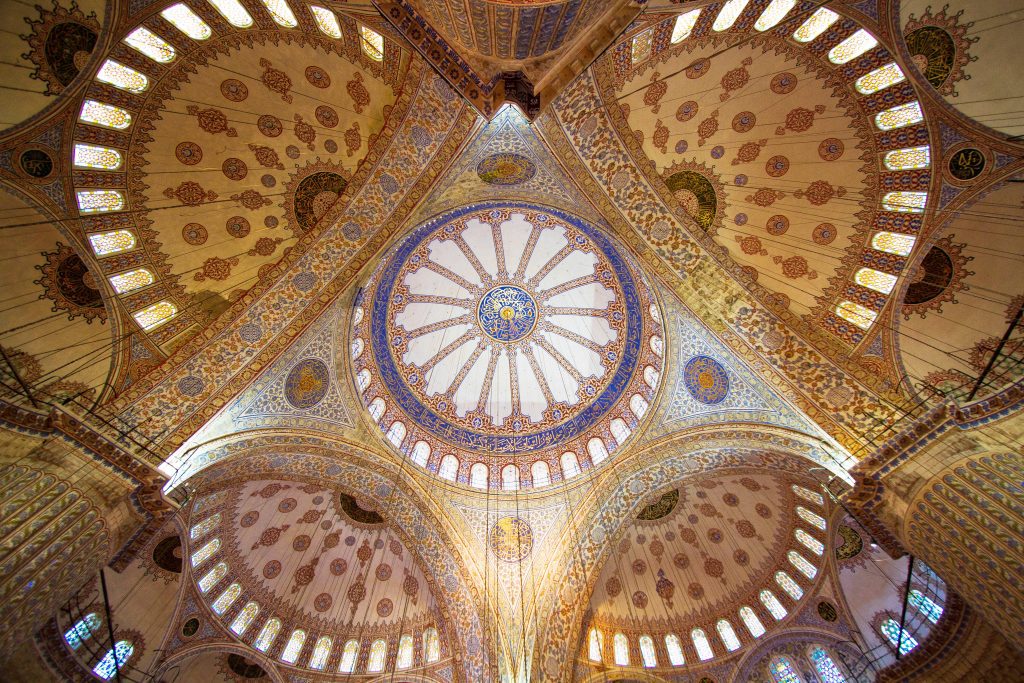
The interior decoration of the Blue Mosque is particularly famous. More than 20,000 handmade Iznik tiles cover the walls and galleries, featuring intricate floral patterns and geometric designs. These tiles, produced in the renowned Iznik tiles, are responsible for the mosque’s popular name, “Blue Mosque,” which was given by Western travelers who admired the dominant blue tones of the interior decoration.
Additional decorative elements include finely crafted stone carvings, wooden doors, metalwork, and painted ornamentation known as “kalem işi.” The mihrab (altar), minbar (pulpit), and the sultan’s private prayer area are remarkable examples of Ottoman craftsmanship.
Today, the Blue Mosque continues to function as an active place of worship while also welcoming millions of visitors each year. With its elegant domes, towering minarets, and richly decorated interior, the Blue Mosque remains one of the most iconic symbols of Istanbul’s architectural and cultural heritage.
Browse The Map
Reviews And Comments
Suggested Listings
Little Hagia Sophia Mosque

Suleymaniye Mosque, ISTANBUL

Yildiz Hamidiye Mosque

Not rated yet.
Why don't you register your impressions?