


Contact
- Güllübahçe, 09200 Söke / Aydın, Türkiye
- +90 (0256) 547 11 65
- info@allabouturkiye.com
Where Ancient Stones Whisper History
| MMonday | 08:30 AM - 19:00 |
| TTuesday | 08:30 AM - 19:00 |
| WWednesday | 08:30 AM - 19:00 |
| TThursday | 08:30 AM - 19:00 |
| FFriday | 08:30 AM - 19:00 |
| SSaturday | 08:30 AM - 19:00 |
| SSunday | 08:30 AM - 19:00 |
Hidden among the forested hills of Türkiye’s Aegean coast, Priene Ancient City stands as one of the most intellectually and architecturally refined settlements of classical antiquity. Once a thriving Ionian port city, Priene is today a remarkably preserved archaeological site located near the village of Güllübahçe, approximately 35 km south of Kuşadası.
Founded in a strategic position overlooking the fertile Meander (Menderes) Plain, Priene flourished particularly during the 4th century BC, when it was rebuilt following a strict grid plan. This urban layout is widely attributed to the influence of Hippodamus of Miletus, the pioneer of rational city planning. Streets intersect at right angles, dividing the city into carefully organized residential, civic, and sacred zones—an approach that reflects the philosophical ideals of balance and order in the ancient Greek world.
Walking through Priene today, visitors encounter one of the clearest surviving examples of Hellenistic urban design. Stone-paved streets, still visibly aligned, lead to public buildings, agoras, and private houses that reveal how daily life was structured nearly 2,400 years ago. The city’s steep hillside setting adds dramatic perspective, with terraces rising gradually toward the acropolis.
Among Priene’s most significant monuments is the Temple of Athena Polias, designed by the renowned architect Pythius, who also contributed to the Mausoleum of Halicarnassus. Dedicated to Athena, the goddess of wisdom, the temple symbolizes Priene’s intellectual and civic identity. Nearby, the theater, with seating for approximately 5,000 spectators, remains one of the best-preserved Hellenistic theaters in Anatolia, offering insights into ancient performances, assemblies, and public life.
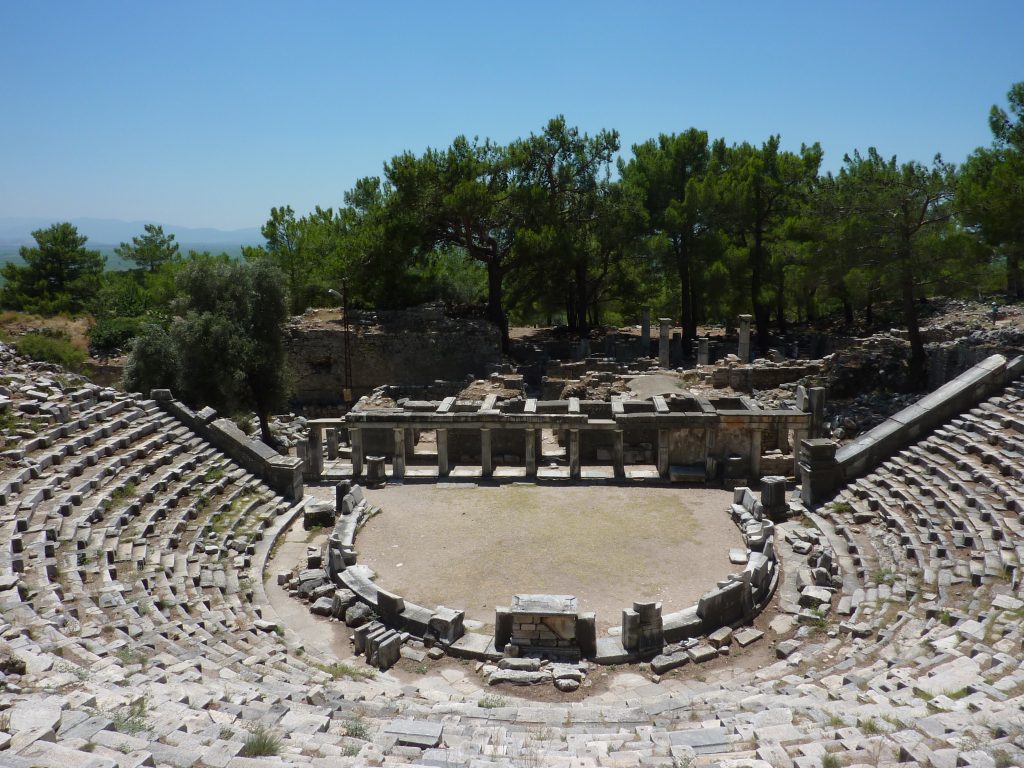
Other notable structures include the bouleuterion (council house), gymnasium, sacred stoas, and well-planned residential quarters, all reflecting a city that valued civic participation, education, and aesthetics. Unlike many ancient cities that were continuously rebuilt, Priene was gradually abandoned, allowing its original layout to survive with minimal later alteration.
One of Priene’s greatest charms is its atmosphere. Far from the crowds of larger archaeological sites, Priene remains quiet and contemplative. As you explore the ruins, the silence is broken only by wind and birdsong, creating a sense of intimacy with the past. From the upper terraces, sweeping panoramic views stretch across the Menderes Plain toward the distant mountains, reinforcing the city’s timeless setting.
A visit to Priene pairs naturally with nearby Miletus and Didyma, forming a classic archaeological route through ancient Ionia. Together, these sites offer a comprehensive picture of religious, urban, and intellectual life along Türkiye’s southwestern coast, making Priene an essential destination for travelers drawn to archaeology, history, and thoughtfully preserved landscapes.
Browse The Map
Reviews And Comments
Suggested Listings
Didyma Ancient City, Aydın

Miletus Ancient City, Aydın

Aphrodisias Ancient City – Aydın

Not rated yet.
Why don't you register your impressions?